Tutoring by Everitt Clark
  • Home
  • How I Tutor
  • Testimonials
  • SAT vs. ACT
    • SAT/ACT Concordance Chart
    • Useful Links
    • About Ev
    • Contact
    • Blog

    SAT or ACT:  Choose Wisely!


    If you take a stroll down the “Test Preparation" aisle of your local bookstore, you'll see several dozen books about how to prepare for the SAT and almost as many about the ACT. Search for a guide to the differences between the two tests, though, and you're probably out of luck. The major test prep companies certainly don't have an incentive to enlighten you, since they would rather sell you two books than one. Consequently, many students start from square one when the time comes to decide which exam to take. The ubiquitous clichés about the two tests - “the ACT is easier", or “some schools prefer the SAT" - only make matters worse.

    In order to clear up some of the confusion, I give a free 40-minute presentation at libraries and high schools in northern Virginia and Washington, DC entitled “SAT or ACT: Choose Wisely!" My primary goal is to cut through the platitudes and present the facts about the two tests, so that by the end of the lecture a typical student will know which exam is right for him or her.  My secondary (but still critical) goal is to inform students and parents about the dubious history and purposes of the two tests, so that they can approach the examinations with a healthy skepticism rather than a sense of dread.  If you would be interested in having me speak at your local school or library, please write to me.

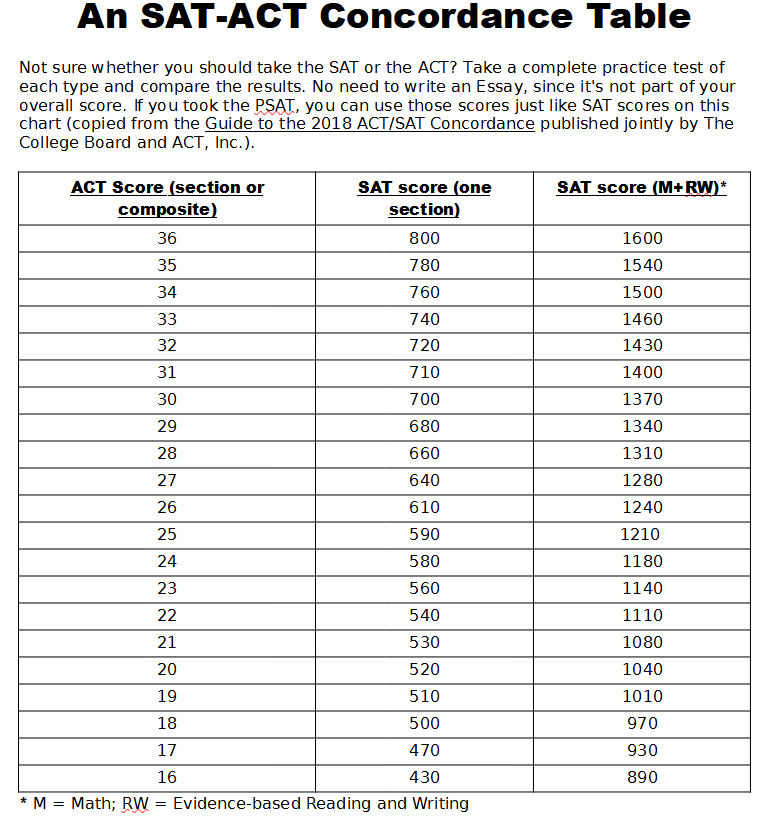
    In the meantime, this chart will help you compare SAT and ACT scores; and the following excerpt from my upcoming book, Choose Wisely: the SAT, the ACT, and You, will hopefully set a few matters straight.


    Five myths about the SAT and the ACT.


    There are certain misconceptions about the SAT and the ACT that just refuse to die. Here are the five I encounter most often.

    • Some colleges (mainly on the east and west coasts) prefer the SAT, while other colleges (mainly in the midwest or the deep south) prefer the ACT.

    False. Since 2006, both tests have been accepted at every four-year college in the United States. Don't believe me? Take it from USA Today.  You don't need to figure out which test is right for which college; you just need to figure out which test is right for you. 

    • The ACT is easier than the SAT.

    False. If this were true, then everyone would of course take the ACT instead of the SAT. It is true, however, that some students do much better on one of the two tests. To understand why this is the case, it helps to know a little about the historical background and intentions of each test. We'll cover that in detail in the next chapter. For now, let it suffice to say that the SAT is difficult because of its devious wordings and trap answer choices, whereas the ACT is difficult because of its intense time pressure.  They're each hard, but for different reasons.

    • The ACT is more knowledge-based than the SAT.

    False (mostly). The ACT was initially designed to test “college readiness” (e.g. grasp of the high-school curriculum), whereas the SAT purported to measure “scholastic aptitude” (e.g. intelligence, but we're not supposed to say that).  Nowadays, though, it's a wash. The infamous ACT Science section, for example, requires virtually no knowledge of science: if you can read charts and graphs quickly, you're set. And so what if ACT Math covers more advanced topics (trigonometry and logarithms) than SAT Math? SAT Critical Reading balances the scales by testing difficult vocabulary more extensively than ACT Reading.
         The examinations have come to resemble each other more and more closely over the years. ACT, Inc. shrewdly realized that it could compete with College Board for business - and standardized testing is big business - if schools regarded the SAT and the ACT as interchangeable parts. Hence, when the SAT added an essay to their test in 2005, the ACT added their own essay within a month, scored in exactly the same way. If that's a coincidence, then I'm the Queen of England.

    • Whatever their flaws, the SAT and the ACT at least provide a more objective way than high school GPA to compare students.

    False. Forget for a moment about the well-publicized disparities in SAT and ACT scores between men and women, Caucasians and minorities, or rich and poor. Recent studies have shown that the SAT and the ACT both pale in comparison to good ol' High School GPA in predicting how well students will perform in college. It's not even close.

    • You can't prepare for the SAT because it tests aptitude rather than knowledge.

    False, false, a million times false! ETS and the College Board repeat this canard ad nauseum because their whole house of cards collapses without it. The SAT is like a crooked poker player, one who plays dirty and then claims he beat you fair and square. Trap answer choices, confusing wordings, and penalties for incorrect responses are just a few of the tricks up its sleeve. But you can learn to spot the trap answer choices; you can train yourself to translate the verbal gymnastics into normal English; and you can minimize the guessing penalty by learning when and when not to guess. The SAT's brand of “aptitude” has little to do with how good a student you are. What the test actually measures is a very coachable amalgam of discipline, guile, and adroitness with concepts. (Did I mention that the SAT tests your vocab – yet another thing you can prepare for?) The ACT folks, on the other hand, at least have the decency to admit that you can prepare for their test. They're right.

    Create a free website with Weebly